




Business Challenge
The client faced several key challenges that were limiting growth and operational efficiency:
- Inefficient lead management: The client struggled to effectively capture, track, and manage leads, resulting in a negative impact on sales performance.
- Lack of mobility: Employees needed mobile access to customer data and schedules, but existing systems were not designed for field use.
- Limited business intelligence: The client lacked proper reporting and analytics to assess employee efficiency, track tasks, and evaluate customer engagement.
- Disconnected processes: Existing systems weren’t integrated, leading to inefficiency and duplicated effort.
The client needed a customized CRM solution that could seamlessly integrate existing tools, streamline data flow, and empower employees with on-the-go access.
Solution
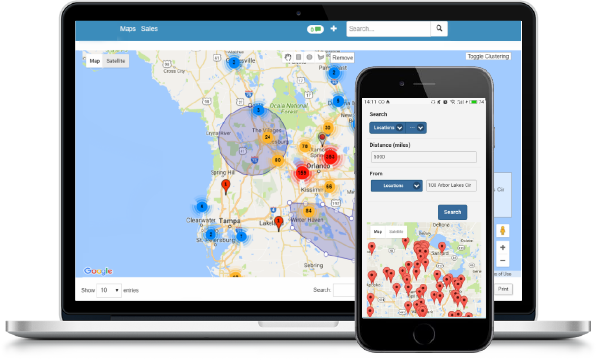
DevCom delivered a tailored HomeCare CRM solution that centralized lead management, automated key sales workflows, and improved overall data flow across departments. The main goal of the solution is to enable company employees to work with the CRM on multiple devices, both stationary and mobile. HomeCare CRM has all the necessary features for optimizing and improving the productivity of on-the-go employees. Its agile design isn’t just flexible. It helped solve the client’s immediate issues and gave them something to build on for the future. The company can now operate more efficiently, improve sales, and give customers better service.
The implementation of HomeCare CRM provided measurable business benefits:
- Reduced administrative costs by automating manual tasks.
- Boosted sales performance through improved lead management.
- Increased employee productivity with mobile-friendly access to customer data and routes.
- Better customer service with support for special requests and personalized communication.
- Stronger decision-making powered by advanced reporting and analytics.
Results
The revised plan allowed progress in the realization of this solution. By deploying new application on a separate dev environment and gradually synchronizing data between the old and new applications, the team achieved a seamless transition. The new application, built on Java and Angular, successfully addressed the client’s requirements for improved data presentation and process optimization. Deploying a PHP app to Azure ensured scalability and enhanced performance. Finally, the phased shutdown of the old PHP application upon completion of all functionalities ensured a smooth transition.
As outlined in this on-premise to Azure cloud migration case study, the migration resulted in a fully optimized, cloud-ready application. The successful Azure application migration not only enhanced performance but also established a reliable framework for future projects.
Features
 1. Admin Panel – Centralized management of customers, employees, and services
- 2. Maps Module – Driving time estimates and optimized routing
- 3. User Dashboard – Personalized access to tasks, reminders, and schedules
- 4. Reminders – Notifications for visits, deadlines, and special tasks
- 5. Lead Management – Automated lead tracking across the entire customer journey
- 6. Reporting – Insights into employee efficiency, extra task handling, and contribution margins





















.svg)