



Every successful software project begins long before the first line of code is written. The discovery phase of a software development project is a crucial preparatory stage in which the team clarifies goals, aligns with customer requirements, and defines project specifications within the broader project lifecycle.
During this phase, stakeholders — including business representatives, end users, and technical specialists — collaborate to align business objectives with business and user needs and to uncover potential constraints. Research shows investing more time in discovery reduces the risk of project failure by 75%.
In this article, we’ll explore how the software discovery phase works, what deliverables it produces, and why it plays a critical role in modern software development.
What Is the Discovery Phase of a Software Project?
The discovery phase in software development is a structured research and planning stage that precedes active development. The goal of the discovery stage is to clarify business needs, refine business objectives, and align stakeholder needs to define the most effective solution within project constraints. Essentially, the discovery phase answers three critical questions:
During this phase, the Discovery team — typically including a business analyst, technical lead, project manager, and UX/UI designer — works closely with key business stakeholders, such as decision-makers, subject matter experts (SMEs), and product owners.
An essential aspect of discovery involves identifying and understanding stakeholders, which are individuals or groups who are affected by or can influence any changes, either directly (system users) or indirectly (those relying on its outputs).
To identify stakeholders effectively, the team considers:
- Users and their needs, including those who interact with the system directly or are affected by its outputs
- Decision-makers, including their level of authority, influence, and responsibility for approvals (e.g., budget, scope, timelines)
- Subject matter experts (SMEs) with domain or technical expertise, such as product owners or client-side specialists, who provide insights into current processes and constraints
- Organizational structure, including departments involved, stakeholder relationships, levels of influence (operational, managerial, technical), and dependencies
- Workflow touchpoints and impacted parties, identifying where stakeholders interact with processes and how changes may affect them
Interviews, workshops, process modeling, and document analysis ensure all relevant stakeholder perspectives are identified and considered. By asking questions like, “Who else is affected by this change?” or, “Who should be involved in decision-making?”, the team identifies key stakeholders and their roles.
The discovery phase typically includes activities such as:
- Stakeholder identification and analysis
- Business process analysis and modeling
- User research and persona definition
- Requirements elicitation and analysis
- Product vision and scope definition
- Technical feasibility and solution assessment
Without proper preparation, development teams often struggle with unclear priorities, changing requirements, and unexpected risks. By the end of the discovery phase, the team has enough clarity to define the project scope, outline the solution, and move forward with implementation more confidently.
When Is a Discovery Phase Needed?
The discovery phase is a crucial step if a project’s goals, requirements, or context are not fully defined. It helps the team identify the best solution and reduce misunderstandings, technical risks, and costly missteps.
Essential Step
Some projects benefit most from a comprehensive discovery phase:
- Complex or non-standard projects: Projects involving multiple stakeholders, complex integrations, intricate business logic, or a sophisticated architecture.
- Unclear requirements: When there’s a strong idea but no clear implementation plan or a detailed vision.
- Aligning expectations: Particularly important for fixed-price projects to prevent scope creep and ensure clarity and alignment among stakeholders.
Non-Essential Step
Not every project requires a full discovery phase. In some cases, a lighter approach is sufficient:
- Standard solutions: Template-based websites, CRM systems, or simple applications can proceed with a high-level review of requirements, references, and basic specifications.
- Repeat collaborations: Continuing work with an existing client may require only one or two focused sessions and an internal audit.
- Complete specifications or prototypes provided by the client: A targeted analysis to identify potential risks may replace a full discovery phase.
- Strict time or budget constraints: Early-stage startup pilots or low-cost solutions may rely on rough estimates, minimal functionality, and rapid validation rather than a formal discovery process.
Goals of the Discovery Phase in Software Development
The discovery phase aims to create shared understanding between stakeholders and the development team, ensuring the problem, context, and expectations are clearly defined before moving into solution design.
In software development this phase directly impacts how accurately the final solution reflects business and user needs. More specifically, the discovery phase in software product development focuses on several key objectives:
Clarifying the Problem
A clear understanding of the core business challenge is essential before exploring solutions. Early concepts or proposed approaches may not fully reflect the underlying problem.
The discovery phase helps uncover root causes and ensures the team is solving the right problem.
Identifying Stakeholders
The discovery phase involves identifying all relevant stakeholders who influence or are impacted by the product. These may include:
- Customers and end users
- Business stakeholders and sponsors
- Domain subject matter experts (SMEs)
- Implementation SMEs (e.g., architects, developers)
- Operational and support teams
- Regulatory or compliance stakeholders
Failing to identify key stakeholders early can lead to misalignment, overlooked requirements, and rework later in the project.
Defining Product Vision
The discovery process also establishes a clear product vision — a shared understanding of what the product should achieve and how success will be measured.
Validating Assumptions
Early-stage ideas are often based on assumptions. The discovery phase helps validate these assumptions through research, workshops, and analysis, reducing uncertainty and enabling better decision-making.
Benefits of the Discovery Phase in Software Development
The benefits of discovery phase in software projects go far beyond documentation. A well-executed discovery stage directly contributes to overall project success.
Reduced Development Risk
By identifying technical challenges early, teams can address potential issues proactively and avoid costly rework during development.
Better Cost and Time Estimates
A structured discovery-phase project plan provides the team with a solid foundation for accurately estimating time, effort, and cost.
Without discovery, estimates often rely on guesswork.
Improved Stakeholder Alignment
Discovery workshops help align expectations among key stakeholders across business, product, and technical domains.
User-Focused Products
Through user research and persona development, teams ensure that the product addresses real user needs and delivers meaningful value.
Clear Development Roadmap
At the end of the discovery phase, the team has a clear roadmap that guides the next stages of the project and supports more predictable delivery.
Discovery Toolkit: Key Methods and Frameworks
Although the exact process varies between companies, most discovery phase steps follow a similar structure.
1. Stakeholder Identification and Analysis
The team identifies and analyzes all stakeholders who influence or are impacted by the product.
This includes not only listing stakeholders but also understanding their roles, expectations, level of influence, and involvement in the project.
Common techniques include:
- Stakeholder list, map, or personas
- interviews and workshops
- Organizational modelling
- Process modelling
Key stakeholders may include business representatives, end users, and subject matter experts (SMEs).
A clear understanding of stakeholders ensures effective communication, better decision-making, and reduced risk of misalignment. This tool is also recognized in the BABOK® Guide as a core competency of effective business analysis.
2. Concept Modeling
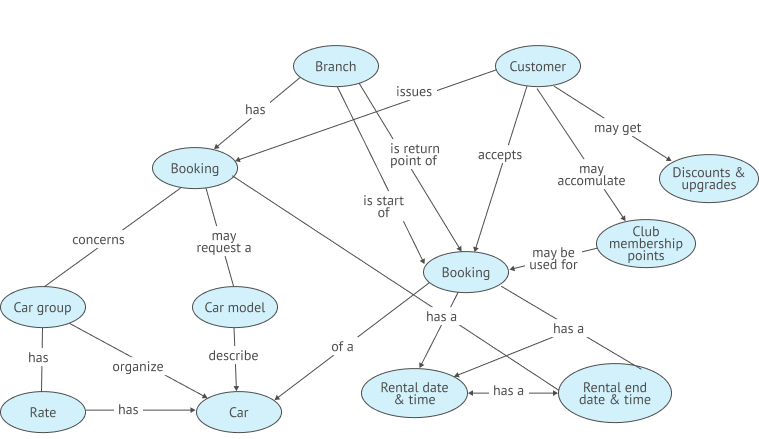
Concept modeling structures and clarifies domain knowledge by identifying key entities, relationships, and interactions within the system. It is often used by business analysts to explore and formalize understanding of a domain — especially when it is new, complex, or poorly defined — and to establish a shared language between stakeholders and the development team.
Core elements include:
- Entities (nouns): people, roles, systems, documents
- Relationships: meaningful connections between entities
- Interactions (verbs): how entities interact or relate to one another
A well-structured concept model reduces ambiguity, aligns terminology, and supports consistent communication throughout the project. The BABOK® Guide recognizes concept modeling as a key analytical technique precisely for this reason — it creates the shared understanding that makes requirements elicitation more accurate and productive.
3. Business Process Modeling & Jobs to Be Done (JTBD)
Understanding the current state is critical.
Teams analyze existing workflows to understand how work is performed today and identify inefficiencies, constraints, and risks.
- Understand the current context (“as-is”) – analyze existing processes: who does what, in what sequence, and why. Focus on what users are trying to achieve, not just their actions.
- Identify Job Executors – determine who performs the key functional tasks; these will be the focus of JTBD research.
- Define Functional Job Steps – structure tasks using a Universal Job Map: Define, Locate, Prepare, Confirm, Execute, Monitor/Modify/Conclude.
- Formulate Desired Outcomes – for each step, specify outcomes such as “Minimize the time it takes to [metric] the [object] [context]” or “Minimize the likelihood that [negative result] [context].”
Determine Core Jobs – identify the primary job users are trying to accomplish, along with related emotional or social jobs if relevant. Use actionable verbs that point to a concrete result (such as “define data,” “retrieve a file,” “configure parameters”), and avoid vague process verbs like “review,” “check,” or “manage,” which describe activity without indicating an outcome.
4. User Research
User research helps teams understand how real users interact with systems.
Common techniques include:
This step ensures the product addresses real needs rather than assumptions.
5. Problem Definition
Before proposing solutions, teams focus on clearly defining the problem. A useful technique here is the Problem Statement Canvas, which:
- Defines the core problem before exploring solutions.
- Clarifies who is affected, when and where the problem occurs, and why it matters
- Captures how the problem is currently addressed.
This approach prevents vague or overly broad problem definitions and ensures the team focuses on real business challenges.
 Problem
Business problem statement
Lost revenue due to inefficient use of technicians’ working time:
- Significant time is spent on administrative tasks
- Technicians need to create and manage separate jobs for each asset, sometimes handling a very high volume weekly.
- In some cases, there is limited or no internet connectivity on-site, requiring technicians to take notes offline and later re-enter them into the system.
 Context
When and where the problem occurs?
When technicians are working on-site:
- Either servicing assets in transit (e.g., in a vehicle)
- Or working at a fixed location where equipment cannot be moved
 Current Alternatives
What is currently done to solve the problem?
- Using a mobile application to capture and upload photos of assets
- Taking notes offline (e.g., on paper or other temporary means) and entering the data into the system later
 Affected Stakeholders
Who is most affected by the current process?
- Field Technicians
- Potentially Operations or Coordination Teams
 Impact
What are the quantifiable and emotional impacts?
- Frustration caused by duplicate data entry (offline → system)
- Reduced efficiency due to managing multiple jobs instead of a more streamlined process
 Shortcomings of Current Alternatives
What are the limitations of existing solutions?
- Mobile tools are often optimized for limited tasks (e.g., photo capture), and are less convenient for comprehensive data entry
- The process requires duplicate work, increasing time spent and risk of errors
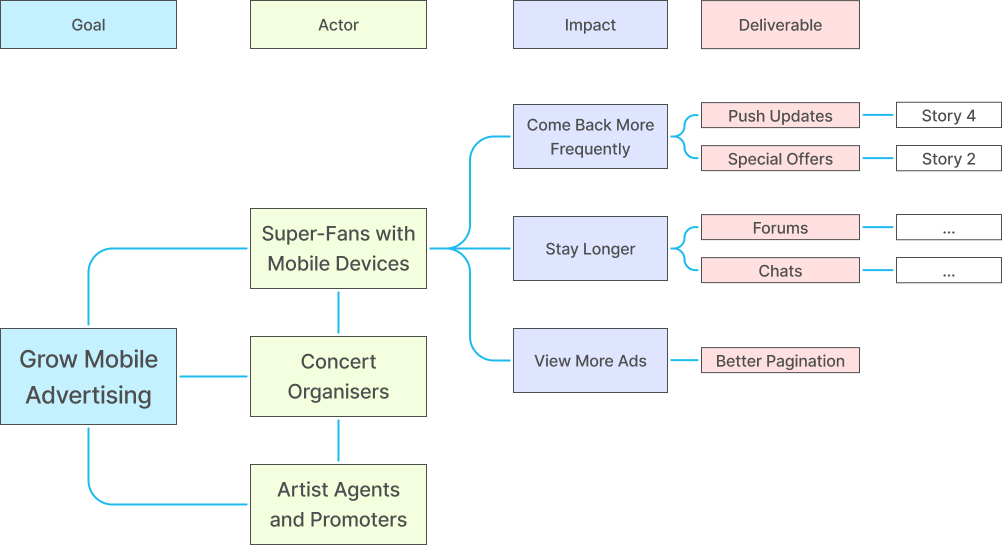
6. Impact Mapping
Helps prevent scope creep, incorrect assumptions, stakeholder-driven features, and random prioritization.
Key elements:
Once goals are defined, impact mapping connects objectives to actionable solutions, especially in ongoing projects, enabling teams to decompose goals into concrete features.
Discovery Agenda Planning Principles
To make the discovery process efficient and respectful of participants’ time:
- Respect schedules and availability: Consider client calendars, workloads, and time zones; plan sessions according to stakeholder availability.
- Leave buffers: Include time between meetings to prepare and reflect on outcomes.
- Frequent check-ins: Short internal progress reviews help prevent scope drift.
- Finish meetings early: Ending 10 minutes ahead allows participants to prepare for the next session.
- Focus on critical topics: Prioritize essential content (MVP, pilot, or Phase 1); draft a full agenda first, then trim to focus on what matters most.
- On-site planning: Avoid overloading the last day; spread sessions to maintain attention and energy.
Discovery Phase Timeline: How Long Does It Take?
The duration of a discovery phase depends on project complexity, stakeholder availability, and the depth of research required. A typical engagement spans 2–6 weeks in total and usually includes 2–3 days of intensive on-site or remote workshops with key stakeholders, followed by interviews, internal analysis, and documentation. The workshop sessions are where assumptions are surfaced, and alignment is built; the weeks around them are where findings are synthesized into actionable deliverables — scope definition, requirements gathering, and a clear roadmap for development.
Examples of the On-Site Workshops Agenda
Example Agenda: Day 1
| Time | Activity | Stakeholders | Output |
|---|---|---|---|
| 10:00 – 11:00 (~1h) | Kickoff Meeting | PO, PM, BA, SA, Designer | Communication Plan |
| 11:30 – 13:30 (~2h) | Intro: Problem Statement | PO, PM, BA, SA, Designer | Business Requirements |
| 13:30 – 14:30 (~1h) | Lunch | PO, PM, BA, SA, Designer | — |
| 14:30 – 16:30 (~2h) | Observation Session (Business Processes) | PM, BA, Designer | Notes |
| 17:00 – 19:00 (~2h) | Recap | BA, SA, Designer | Business Context Diagram, RACI Matrix |
Example Agenda: Day 2
| Time | Activity | Stakeholders | Output |
|---|---|---|---|
| 10:00 – 12:00 (~2h) | Business Processes Workshop | PO, PM, BA, SA, Designer | As-Is Process Flow Diagram |
| 12:30 – 13:30 (~1h) | Personas and User Roles Workshop (Part 1) | PM, BA, SA, Designer | User Roles Description |
| 13:30 – 14:30 (~1h) | Lunch | BA, SA, Designer | — |
| 14:30 – 15:30 (~1h) | Personas and User Roles Workshop (Part 2) | PM, BA, SA, Designer | Draft Personas |
Effective Workshop Tips
- Involve all key participants during Business Processes workshops to get a complete picture and uncover bottlenecks.
- Detailed personas help the team understand users’ needs, pain points, and goals, enabling more focused product design.
Example Agenda: Day 3
| Time | Activity | Stakeholders | Output |
|---|---|---|---|
| 10:00 – 12:00 (~2h) | Business To-Be State Workshop | PO, PM, BA, SA, Designer | Product Vision |
| ~3h (flexible) | User Research: Interviews (2 per day) | Interviewer, BA, Designer (optional) | Notes, Recordings, Validated Hypotheses |
| 13:30 – 14:30 (~1h) | Lunch | BA, SA, Designer | — |
| ~3h | Recap & Internal Activities | BA, SA, Designer | To-Be Process Flow Diagram, Use Case Matrix |
This approach demonstrates how a discovery phase can be structured efficiently while respecting stakeholders’ time and ensuring all critical information is collected for informed decision-making.
Deliverables of the Discovery Phase
The discovery phase produces a set of concrete outputs that give the development team everything they need to begin work with confidence. Deliverables vary by project, but a well-run discovery typically produces the following.
Product Vision and Scope
Defines the product’s purpose, goals, and boundaries, answering the questions of what exactly will be built and what is explicitly out of scope. This document becomes the reference point for all subsequent decisions about features, priorities, and trade-offs.
Stakeholder Register
A structured record of all stakeholders, including their roles, responsibilities, level of influence, and preferred communication channels. It ensures no key decision-maker is overlooked as the project progresses.
Requirements: User Stories, Use Cases, and Requirements Management Plan
User stories capture functionality from the user’s perspective (“As a [role], I want to [action] so that [outcome]”). Use cases provide more detailed descriptions of how users interact with the system to accomplish specific goals. Together, they form the basis for backlog creation and development planning.
The Requirements Management Plan defines how requirements will be collected, prioritized, and updated as the project evolves. This reflects the requirements life cycle management practices described in the BABOK® Guide: ensuring nothing discovered during this phase gets lost or drifts out of alignment as development progresses.
Prioritized Feature Backlog
A ranked list of features and functionalities, reflecting both business value and implementation complexity. This gives the development team a clear starting point and supports realistic sprint planning from day one.
Business Process Models
Visual representations of current (“as-is”) and future (“to-be”) workflows, showing how work moves through the organization and where the new system fits in. These reduce ambiguity and help the team design solutions that match how users actually work.
UX Artifacts: Wireframes or Prototypes
Depending on project complexity, discovery may produce low- or mid-fidelity wireframes that visualize key user journeys and interface concepts. These are not final designs — they are alignment tools that help stakeholders react to something concrete before development begins.
Technical Architecture Outline
A high-level description of the proposed solution architecture, including technology choices, integration points, and any infrastructure considerations. For projects with compliance or security requirements, this section also captures relevant constraints.
Risk Register
A log of identified risks — technical, organizational, and scope-related — along with their likelihood, potential impact, and proposed mitigation strategies. Surfacing risks during discovery is far less costly than encountering them mid-development.
Communication Plan
Defines how the team and stakeholders will stay aligned throughout the project: meeting cadence, reporting structure, escalation paths, and communication channels.
How Much Does the Discovery Phase Cost?
The cost of a project discovery phase in software development varies depending on project scope and complexity. Key factors that influence pricing include:
- Project complexity and technical requirements
- Number of stakeholders involved
- Depth of research and analysis
- Number and type of workshops conducted
- Documentation and deliverables required
As a rough guideline:
- Small projects typically involve a discovery investment in the range of $5,000–$10,000.
- Mid-size products may require around $10,000–$25,000.
- Large enterprise initiatives often exceed $25,000.
While this represents an upfront cost, the discovery phase is a strategic investment. By uncovering risks, clarifying requirements, and aligning stakeholders early, it helps prevent costly redesigns and scope changes later in the project, often saving far more than initial costs.
Common Mistakes During the Discovery Phase
Even with careful planning, discovery phases can go off track if certain pitfalls are not avoided. The three most common mistakes are:
1. Focusing on the Solution Instead of the Problem
- Analysts or team members jump to proposing solutions before fully understanding the underlying issue.
- Early assumptions or previous experiences are applied to a new case without proper validation.
- Premature solutions can impose limitations on problems that are not yet fully understood.
2. Weak or Missing Stakeholder Analysis
- Teams fail to identify who makes decisions, who uses the system, and who influences outcomes.
- Without a structured approach, stakeholder engagement may unintentionally prioritize visibility over authority, leaving key voices underrepresented
- Misalignment occurs if key decision-makers appear late or are not engaged properly.
3. Vague or Overly Broad Problem Statements
- Problems are defined too generally (e.g., “The system is slow”) rather than precisely (e.g., “Page X takes 7 seconds to load, exceeding the acceptable 3 seconds”).
- Without clarity, the team may spend the entire discovery phase addressing the wrong issue.
- Lack of a clear communication plan, such as coordinating time zones, availability, and channels, can further reduce efficiency.
Discovery Phase Example: Real Project Workflow
Imagine a healthcare organization planning a digital platform for patient appointment management and care coordination. The project discovery phase in such a project might include:
 Kickoff workshop with executives, clinical leads, and product managers.
- Stakeholder interviews with doctors, nurses, administrative staff, and IT personnel.
- Observation sessions analyzing current patient flow, scheduling processes, and record-keeping practices.
- Business process modeling to visualize clinical and administrative workflows.
- User persona creation for patients, physicians, and administrative staff.
- Impact mapping to connect proposed product features with clinical outcomes and operational goals.
At the end of the healthcare software discovery phase, the team typically delivers:
- A product vision document outlining goals and success criteria.
- A prioritized backlog of features and functionalities.
- Architecture recommendations for secure, compliant system design.
- Time and cost estimates for implementation.
Only after completing these discovery activities does development begin, ensuring alignment with clinical needs, regulatory requirements, and user expectations.
Conclusion
The discovery phase is a foundational step in software development, ensuring ideas are validated, structured, and technically feasible before implementation begins. It connects market research, project requirements, and technical specifications into a cohesive execution strategy.
Understanding what a discovery phase in software development is and applying it effectively helps teams align business goals, user needs, and technical constraints into a single direction. By aligning stakeholders, validating technical feasibility, and defining a clear development roadmap, organizations reduce uncertainty and significantly improve delivery success.
Partnering with DevCom ensures your discovery phase is thorough and effective. Our certified experts help define requirements, align stakeholders, and create actionable plans so your development team starts with confidence. Explore our Discovery Phase Services to get started.
Discovery Phase FAQ
The discovery phase is an early stage of a project where teams analyze business goals, user needs, and technical requirements before development begins.
It reduces project risk, improves requirement clarity, and helps teams align on the product vision.
Typical participants include:
- Business owners
- Product managers
- Business analysts
- Software architects
- UX designers
- Developers
Subject matter experts often contribute domain knowledge as well.
An effective discovery phase project plan should include:
- Stakeholder interviews
- Problem definition workshops
- User research
- Process analysis
- Defined deliverables and success criteria
Structured workshops and regular communication are key.
Most discovery phases last between 2 and 6 weeks, depending on project complexity.
Even MVP projects benefit from a lightweight discovery phase.
It ensures that the MVP focuses on the most important features and solves a real problem.



























.svg)